

Kuleana (pronnounced /ku.leˈa.na/) Pono (pronounced [ˈpono])
Embedded in the Hawai‘i state motto, Ua Mau ke Ea o ka ʻĀina i ka Pono, is the concept of Pono—often translated as 'the life of the land is perpetuated in righteousness.' While Kuleana is a foundational concept representing the reciprocal relationship between responsibility and privilege, at Hula Anyone, we recognize both as multi-dimensional mandates for balance, ethical integrity, and ancestral alignment. To us, being Pono means ensuring our organizational practices are in a state of 'perfect order'—harmonizing our cultural stewardship with social responsibility. For Hula Anyone, Kuleana is the sacred intersection of privilege and accountability; it is our 60-year responsibility to the ancestors to ensure that our organizational transparency is as authentic and disciplined as the ancient protocols we preserve. We strive to be Pono and practice Kuleana by maintaining equitable access to the arts, fostering transparent community leadership, and ensuring that every modern interpretation of our craft remains rooted in the moral and spiritual excellence of our heritage.
For your convenience and transparency, all official Hula Anyone Inc. governance documents and 501(c)(3) policies are available for download in PDF format at the bottom of this page.
MISSION STATEMENT
Hula Anyone Incorporated is a 501(c)(3) cultural arts organization dedicated to the preservation, education, and stewardship of Polynesian and Asian American Pacific Islander (AAPI) heritage, with a primary focus on the traditional and contemporary disciplines of Hula, Tahitian (ʻOri Tahiti) dance, language, and music. For over 60 years, our mission has been to foster community resilience, intergenerational mentorship, and cross-cultural equity by providing accessible cultural programming to the Central Coast. By blending ancestral foundations with modern interpretations—including the application of contemporary music to traditional dance forms—we ensure the continued vitality of Pacific Islander arts. Through our 'Bridge to Kaua'i' initiative, we provide critical scholarship support and educational residencies, ensuring that socioeconomic barriers do not impede the transmission of this living heritage. We are committed to sustainable cultural advocacy, social inclusion, and the empowerment of diverse AAPI communities and their allies through the transformative power of the Aloha Spirit.
ARTICLES OF INCORPORATION OF HULA ANYONE INCORPORATED
ARTICLE I: NAME
The name of this corporation is Hula Anyone Incorporated (hereinafter referred to as the "Corporation").
ARTICLE II: CORPORATE STATUS AND PURPOSE
Section A: Public Benefit Status
This Corporation is a nonprofit Public Benefit Corporation and is not organized for the private gain of any person. It is organized under the California Nonprofit Public Benefit Corporation Law for public and charitable purposes.
Section B: Specific and Primary Purposes
The specific, primary, and charitable purposes of this Corporation are to ensure the preservation, education, and stewardship of Polynesian and Asian American Pacific Islander (AAPI) heritage. This includes, but is not limited to:
Providing high-quality instruction, cultural mentorship, and technical training in the traditional and contemporary disciplines of Hula, Tahitian (ʻOri Tahiti) dance, language, and music.
Fostering community resilience, intergenerational mentorship, and cross-cultural equity by offering accessible cultural programming across the Central Coast and surrounding regions.
Operating the "Bridge to Kauaʻi" initiative and dedicated scholarship funds to eliminate socioeconomic barriers, ensuring equitable access to cultural education, educational residencies, and heritage preservation.
Engaging in public performances, historical documentation, and community stewardship to maintain ancestral foundations while celebrating modern artistic interpretations.
ARTICLE III: AGENT FOR SERVICE OF PROCESS
The name and address in the State of California of this Corporation's initial agent for service of process is:
Name: Angelita Eller
Corporate Address: 1675 Shepard Mesa Ln. Carpinteria California 93013
ARTICLE IV: CORPORATE ADDRESS
The initial street address and mailing address of the Corporation is:
Street & Mailing Address: 1675 Shepard Mesa Ln. Carpinteria California 93013
ARTICLE V: TAX-EXEMPT LIMITATIONS
Section A: Internal Revenue Code Section 501(c)(3) Compliance
This Corporation is organized and operated exclusively for charitable, educational, and cultural purposes within the meaning of Section 501(c)(3) of the Internal Revenue Code.
Section B: Limitation on Operational Activities
No substantial part of the activities of this Corporation shall consist of carrying on propaganda, or otherwise attempting to influence legislation, and the Corporation shall not participate or intervene in any political campaign (including the publishing or distribution of statements) on behalf of any candidate for public office.
Section C: Prohibition Against Private Inurement
The property of this Corporation is irrevocably dedicated to charitable and educational purposes, and no part of the net income or assets of this Corporation shall ever inure to the benefit of any director, officer, or member thereof, or to the benefit of any private individual.
ARTICLE VI: DISSOLUTION AND ASSET DEDICATION
Corporate Guarantee: Upon the dissolution or winding up of this Corporation, its assets remaining after payment, or provision for payment, of all debts and liabilities of this Corporation shall be distributed to a nonprofit fund, foundation, or corporation which is organized and operated exclusively for charitable, educational, or cultural heritage preservation purposes and which has established its tax-exempt status under Section 501(c)(3) of the Internal Revenue Code.
ARTICLE VII: INCORPORATOR
The name and signature of the person executing these Articles of Incorporation in the capacity of Incorporator confirms that the information contained herein is true and accurate.
Dated: April 1st, 2026 Angelita Eller, Incorporator
CULTURAL INTEGRITY, LINEAGE PROTECTION, AND STRUTURAL COMPLIANCE
A Mandate of Ancestral Kuleana in the Diaspora
In traditional Hawaiian governance, a hālau hula operates as a sacred, hierarchical ecosystem under the absolute authority of the Kumu Hula—the living foundation and repository of a lineage’s knowledge, spiritual authority, and expressions. Within the Hawaiian Islands, this knowledge is organically guarded by an intact cultural tapestry and the enforcement of kapu (sacred restrictions), where unauthorized copying or the commercial exploitation of a Kumu’s choreography results in swift, devastating social excommunication and systemic exile by the hula community. However, when sacred traditions travel beyond the shores of the archipelago to the mainland, this invisible protective architecture collapses. Operating in a diaspora dominated by Western capitalistic individualism, the hālau encounters actors who do not carry ancestral heritage or fear spiritual hewa (transgression), viewing unique lineages not as a sacred trust to be revered, but as a commercial opportunity to copy, profit from, and exploit.
To fulfill our highest kuleana (sacred custody) to our masters—preserving the pure, uncorrupted lineage of Mahealani McFarland and Kumu Hula Uncle George Naʻope—Hula Anyone Inc. must translate unwritten ancestral kapu into explicit, modern legal frameworks. Because the mainland lacks a localized hula community to naturally enforce accountability, these public compliance policies, alphanumeric asset tracking systems, and restrictive covenants serve as our modern kānāwai (laws of protection). This framework formalizes the transition from reactive copyright enforcement to a strict, pre-emptive pipeline that stops intellectual property theft and lineage contamination before it can reach the public domain. Entrance into this hālau is not a transaction; it is a conditional covenant requiring absolute adherence to these protocols, and any violation will be met with immediate structural expulsion and rigorous legal liability.
CULTURAL INTEGRITY & COMPLIANCE POLICY
He aliʻi ka ʻāina, he kauwā ke kanaka."
The land is chief, man is its servant. In the same structural manner, he aliʻi ka ʻike, he kauwā ka Kumu—the knowledge is supreme, and the Kumu is its servant.
Administrative Framework: Lineage Protection, Fiduciary Safeguards, and Mainland Stewardship
Core Governance Directives
This policy establishes an immutable administrative framework executing three sacred governance mandates:
Protect the Kumu: Guard the physical, artistic, and spiritual integrity of Kumu Angelita Eller and her verified lineage of training (Kumu McKenna / Uncle George Naʻope).
Protect the 501(c)(3): Safeguard the non-profit's corporate assets, public charity status, proprietary curriculum, and legal liabilities.
Be Pono and Practice Kuleana: Maintain balance, structural transparency, and reciprocal responsibility between the institution and its students.
The Pre-Emptive Protection Rule: Traditional retrospective copyright is fundamentally flawed on the mainland, identifying theft only after public exposure and monetization occur. Because traditional island protocols (social excommunication/spiritual hewa) carry no weight among extractive, non-islander actors in distant markets, this policy enforces a proactive digital boundary to stop lineage contamination and asset conversion before materials can reach the public domain.
The Cultural Integrity Pipeline
Phase I: Asset Categorization & Alphanumeric Tracking
All artistic, instructional, and digital outputs are immediately screened and sorted upon introduction into the curriculum:
Common Pool Assets: Historical footnotes, open-source basic steps (kaholo, ʻami), or public mele with standard interpretations. Permissible for classroom execution and supervised public performance.
Lineage Proprietary Assets: Original choreography by Kumu Angelita, specific lineage styling, ʻike hūnā (esoteric interpretations), and all recorded digital curriculum. Strictly confidential; blocked from replication or external teaching.
Unique Asset ID (UAID): Every proprietary asset is cataloged with a tracking code (e.g., HA-MCK-KAH-2026-001) to trace lineage custody and anchor the asset within the 501(c)(3)'s secure property ledger.
Phase II: The Dual-Gate Clearance Process
No lineage-proprietary material may be uploaded, transmitted, or taught via digital portals without clearing two mandatory checkpoints:
Gate A (Internal Material Screen): Automated verification confirming the asset contains embedded digital watermarks, security metadata, and its assigned UAID.
Gate B (Dual-Verification Sign-Off): Require manual authorization from both the Kumu Hula (verifying cultural readiness and lineage purity) and a Board Officer (verifying corporate compliance and asset tracking).
Phase III: Access Control & The Mainland Restrictive Covenant
To replace localized cultural kapu with legally binding accountability, all student access is structured through explicit contractual parameters:
Zero-Download Mandate: All video and audio assets are restricted to end-user-disabled, stream-only protocols. Downloading, local saving, or screen-recording constitutes an actionable breach of contract.
The Anti-Exploitation Covenant: As a non-negotiable prerequisite to instruction, all students must execute a binding agreement codifying:
Lineage Acknowledgment: Express recognition that Kumu Angelita Eller is the sole legal steward and repository of the transmitted knowledge; students waive all personal property claims.
Non-Compete Clause: Departed or expelled students are legally barred for a period of five (5) years from teaching or using hālau material to operate, consult for, or open an independent dance studio within a fifty (50) mile radius of any active Hula Anyone Inc. node.
Liquidated Damages: Violators agree to be held liable for statutory damages, immediate injunctive relief to freeze unauthorized operations, and all legal fees incurred by the 501(c)(3).
Phase IV: Enforcement & Audit Protocols
Quarterly Digital Audits: The Board conducts routine web-scraping and social media tracking of former students and lookalike regional groups to detect unauthorized replication.
Immediate Structural Expulsion: Any individual found leaking insight, bypassing portal protection, or teaching hālau material independently faces immediate termination of all corporate services and permanent lineage excommunication.
Execution of Legal Remedies: Upon breach verification, the Board bypasses mediation to deploy freeze-and-desist orders and launch civil litigation to shield the Kumu's work and protect the organization's non-profit status.
MUTUAL NON-DISCLOSURE AND INTELLECTUAL PROPERTY AGREEMENT
Effective Date: May 31, 2026
Location: Carpinteria, California
E Kō Mai, E Lono: An Introduction in the Spirit of ʻŌhana and Kapu
In the traditional Hawaiian worldview, the hālau (school of hula) is not merely a studio or a recreational space; it is a sacred sanctuary dedicated to the preservation, cultivation, and transmission of ancestral wisdom, spiritual protocols, and lineage-specific cultural expressions. Entrance into the hālau establishes a bond of ʻŌhana (family)—a sacred covenant rooted in mutual trust, respect (hōʻihi), and the collective responsibility to protect the integrity of the teachings.
Coexisting with the spirit of ʻŌhana is the ancient concept of Kapu. Far from being a mere system of restriction, Kapu represents a profound boundary of sanctity. It distinguishes that which is common from that which is sacred, consecrated, and set apart for preservation. To violate Kapu within the hālau is to disrupt the spiritual equilibrium (pono) of the entire lineage and to devalue the lifetime of devotion poured into the arts by the teacher. This Agreement is established not to breed division, but to anchor our boundaries in the modern landscape. It honors the Kuamoʻo lineage of Kumu Angelita Eller, ensuring that her intangible creations—born of the human mind, spirit, and decades of cultural inheritance—remain protected, revered, and secure from unauthorized dissemination or commercial exploitation. In the eyes of the ancestors (Kupuna), she is not an "owner" of the hula, but she is its designated Kahu (guardian/trustee).
1. Definition of Intellectual Property (IP) and Intangible Assets
Unlike physical assets, Intellectual Property protects original ideas, concepts, inventions, and branding, granting creators the legal right to benefit from their work and prevent unauthorized duplication. Within the scope of Hula Anyone Incorporated and the teachings of Kumu Angelita Eller, protected Intellectual Property includes, but is not limited to, the following intangible assets:
● Choreography and Movement: Distinct hula steps, hand gestures (kaona), spatial arrangements, body expressions, and original choreographic sequences developed or transmitted by Kumu Angelita Eller.
● Branding and Educational Methodology: The specific instructional design, curriculum frameworks, lecture materials, historical handouts, and distinct branding assets associated with Hula Anyone Incorporated.
2. Confidential Information and Non-Disclosure Obligations
The Signatory acknowledges that during their tenure, enrollment, or association with Hula Anyone Incorporated, they will be granted access to proprietary and confidential information. In alignment with the principles of Kapu, the Signatory agrees to:
4. Maintain the absolute confidentiality of all unique cultural teachings, concepts, and choreographic suites revealed within the hālau environment.
5. Refrain from teaching, selling, copying, licensing, or commercializing any portion of Kumu Angelita Eller’s proprietary hula choreography, chants, or curriculum outside of officially sanctioned Hula Anyone Incorporated events.
6. Acknowledge that any unauthorized use or disclosure of these intangible assets strips the creator of their rightful recognition, disrupts the cultural lineage, and constitutes a breach of legal and spiritual trust.
3. Strict Media, Recording, and Digital Transmission Protocols
To preserve the sacredness of the learning environment and protect the proprietary nature of the choreography, strict regulations govern the use of recording devices. The table below outlines permitted and prohibited actions regarding media:
Activity / Media Type
Permitted Actions vs Strictly Prohibited Actions (Kapu)
Hālau Practices & Rehearsals
Observation and active physical participation. Note-taking in personal journals for personal study use only.
No unauthorized video or audio recording of any class, rehearsal, workshop, or instructional session using smartphones, cameras, or tablets without prior authorization.
Private Performances & Protocols / Digital Sharing & Social Media
Engaging as a respectful audience member or designated performer under the direction of Kumu Angelita Eller.
Sharing official promotional media explicitly published and authorized by the Hula Anyone Incorporated executive board.
No unauthorized digital recording of sacred ceremonies, private field protocols (e.g., Alaka‘i Swamp protocols), or private community showcases.
No sharing, uploading, or distributing of hālau videos, choreography, or audio clips on social media, public
clouds, or private messaging apps without prior written authorization.
*Note: Any authorized recordings made for personal practice reference must remain confidential, must not be shared with third parties, and must be permanently deleted upon request by the Kumu or the Board of Directors.*
4. Equitable and Legal Remedies
The Signatory acknowledges that a breach of this Agreement causes irreparable harm to Hula Anyone Incorporated and the cultural legacy of Kumu Angelita Eller—harm that cannot be fully remedied by monetary damages alone. In the event of a violation of this Kapu and legal covenant, Hula Anyone Incorporated reserves the right to pursue full legal remedies, including injunctive relief to halt unauthorized use, financial restitution for damages, and immediate termination of hālau membership or association, without prejudice to any spiritual protocols required to restore pono within the community.
COPYRIGHT & PHOTO USAGE RIGHTS
Media Rights, and Right of Publicity
1. Purpose
To establish clear, legally binding guidelines regarding copyright ownership, privacy expectations, public display, distribution, commercial use, and non-restriction of photographs, video, and audio captured during any hālau performance or function.
2. Scope
This policy applies to all public performances, private shows, rehearsals, competitions, workshops, ceremonies, and official hālau functions ("Events"), regardless of location or venue.
3. Copyright & Photographer Ownership
Photographer Ownership: In accordance with federal copyright law, the individual who captures an image (presses the shutter button)—whether a member of the public, an event photographer, or a hālau member—automatically holds the original copyright to that photo.
Subjects Do Not Hold Copyright: Appearing as a subject or performer in a photo does not grant an individual legal copyright ownership of the image.
4. Privacy, Expectation of Privacy, & Hālau Consent
Public & Group Event Privacy Standard: Attendees and performers participating in or attending hālau Events have no reasonable expectation of privacy. Capturing photos of performers, crowds, or bystanders in plain view during these functions is legally permissible.
Personal & Editorial Use: Publishing photos captured at Events to personal social media accounts, personal blogs, or news/editorial coverage does not require a media release from subjects appearing in the background or crowd.
Implied & Automatic Membership Consent: Enrollment, participation, or active membership in the hālau automatically constitutes full consent to be photographed and featured. This consent covers both editorial/personal sharing and official hālau promotional or commercial uses without requiring separate individual release forms for each instance.
Commercial & Promotional Use: Hālau leadership reserves the right to utilize photos containing identifiable members for official marketing, paid advertisements, product promotions, brand endorsements, print materials, and digital media.
5. Grant of Usage Rights to the Hālau
Eligible Media Display: All photographs, digital images, and video footage captured during any Event are eligible for public display, publication, broadcast, and distribution by the hālau.
Scope of Channels: Usage includes, but is not limited to, print media, social media platforms, promotional materials, websites, press releases, archival records, and commercial marketing designated by hālau leadership.
Perpetual Authorization: All usage rights granted under this policy are perpetual, worldwide, and royalty-free.
6. Renunciation of Claims & Compensation
No Subject Rights or Claims: No member, performer, participant, parent, or legal guardian holds copyright claims, privacy claims, or right-of-publicity claims against photos taken during hālau Events.
Waiver of Compensation: Participation is voluntary. No royalties, financial compensation, or residual fees will be provided to any subject or performer for the use of their image, video footage, or likeness.
Waiver of Prior Inspection: Members waive any right to inspect, edit, or approve finished prints, digital graphics, promotional videos, or marketing assets prior to or following publication.
7. Restriction of Authority
Zero Restriction Authority: No individual member, performer, participant, parent, or guardian holds the authority or legal standing to restrict, limit, withhold, or demand the removal of any photo or media taken during hālau Events.
Sole Hālau Jurisdiction: Control over the official publication, retention, distribution, or removal of media managed by the hālau remains solely and exclusively with hālau leadership.
8. Implementation & Compliance
Participation in, attendance at, or enrollment in any hālau Event constitutes full acceptance of and compliance with this Standard Operating Procedure.
Financial Transparency & Nonprofit Status 501(c)(3) Status
Hula Anyone Incorporated is a registered 501(c)(3) tax-exempt nonprofit organization. All donations are tax-deductible to the fullest extent allowed by law. Your support directly funds:
Cultural Education: Providing traditional instruction to students of all ages.
The Scholarship Fund: Ensuring that financial barriers never prevent a dancer from participating in our cultural missions or the Eo e Emalani Festival.
Community Stewardship: Maintaining our 60-year tradition of offering blessings, chants, and performances for Santa Barbara’s maritime and local events.
Official Documentation
For our donors' records and peace of mind, we maintain full transparency regarding our federal standing. You may view or download our official IRS documentation below:
Diversity, Equity, and Inclusion (DEI) & Non-Discrimination Policy
I. Our Commitment to Aloha and DEI - Declaration of Intent: The Power of Ohana
At Hula Anyone Inc., we believe that our "Ohana" (family) is profoundly strengthened by the unique backgrounds, perspectives, and life experiences of every individual who joins our circle. As an organization dedicated to the preservation and celebration of Asian American, Pacific Islander, and Polynesian culture, we recognize that true cultural stewardship requires an unwavering commitment to mutual respect and compassion.
II. Comprehensive Non-Discrimination Statement & Civil Rights Assurance
In accordance with Federal law and U.S. Department of the Treasury/National Endowment for the Arts policy, the Hula Anyone is prohibited from discriminating on the basis of race, color, national origin, sex, age, or disability in its programs and activities.
Title VI of the Civil Rights Act of 1964: Hula Anyone ensures that no person in the United States shall, on the grounds of race, color, or national origin, be excluded from participation in, be denied the benefits of, or be subjected to discrimination under any program or activity receiving Federal financial assistance.
Title IX of the Education Amendments of 1972: Hula Anyone does not discriminate on the basis of sex in its educational programs, workshops, or activities, including admissions and employment, as required by Title IX and its implementing regulations.
Section 504 & ADA: We further certify compliance with Section 504 of the Rehabilitation Act of 1973 and the Americans with Disabilities Act (ADA), ensuring all cultural programs are accessible to individuals with disabilities.
This policy applies to all organizational activities and operations, including but not limited to the hiring and firing of staff, selection of volunteers and vendors, and provision of services to our students.
III. Strategic Pillars of DEI
We are committed to providing an inclusive and welcoming environment for all staff, volunteers, subcontractors, vendors, and students. To achieve this, we adhere to the following pillars:
Diversity: We actively welcome and recruit a multi-generational and multi-cultural community of dancers from all walks of life, ensuring our "Ohana" reflects the breadth of the communities we serve.
Equity: We strive to ensure that our programs, instruction, and public performances are accessible to all, regardless of background or socioeconomic status, removing barriers to cultural participation.
Inclusion: We cultivate a sacred space where every voice—from the Keiki (children) to the Kupuna (elders)—is heard, valued, and respected as a vital part of our cultural legacy.
Advancing Equity and Inclusion We are committed to providing an inclusive and welcoming environment for all members of our staff, volunteers, subcontractors, vendors, and students.
IV. Equal Opportunity
Hula Anyone Inc. is an equal opportunity employer. We will not discriminate and will take affirmative action measures to ensure against discrimination in employment, recruitment, advertisements for employment, compensation, termination, upgrading, promotions, and other conditions of employment. Hula Anyone Inc. maintains rigorous compliance with California’s employment laws (AB5/AB2257), ensuring that all instructors and performers are properly classified and that the organization upholds all labor and tax obligations.
V. Harassment-Free Environment
Hula Anyone Inc. maintains a zero-tolerance policy for harassment in any form. We are dedicated to maintaining a workspace and learning environment that is free from verbal or physical conduct that demeans or shows hostility toward an individual because of their protected status.
VI. Accountability and Reporting
Any individual who believes they have been subjected to discrimination or harassment in violation of this policy should report the incident immediately to the Executive Director or a member of the Board of Directors. All reports will be investigated promptly and with the utmost confidentiality.
Adopted: January 2025 - Reviewed: March 2026 - Next Review: March 2027
Hula Anyone Incorporated - Board of Directors
Angelita Eller - President & Executive Director
Cultural Practitioner, Master Hula Instructor (Kumu), Non-Profit Administrator, Community Advocate, Curriculum Developer, and Heritage Archivist
Cami (Wengler) Vignoe, Ph.D. - Vice President
Academic Counselor, Executive Career Coach, Associate Professor, HR Professional, Researcher, Writer and Storyteller
Angie Bell - Secretary
(Retired) Sales rep at Pacific Diagnostic laboratories
Santa Barbara, California, United States
Eileen Gamboa LONGORIA - Treasurer
Logistics & Operations Specialist, Executive Administrator, Healthcare Advocate, Data Analyst, and Procedural Strategist
Hula Anyone Incorporated
Board Governance & Grant Alignment Framework | Document ID: HA-GOV-2026-W1
Verified Board of Directors & Governance Roles
| Session Cycle | Primary Compliance Focus | Strategic Directives & Grant Milestones | Officer Deliverables |
|---|---|---|---|
| Jan / Feb | Annual Budgeting & Pre-Award Baseline |
|
Treasurer: Master Projections President: Program Schedule |
| Mar / Apr | Campaign Pipeline Review |
|
Secretary: Authorization Resolutions Treasurer: Match-Funding Audit |
| May / Jun | Post-Submission Verification & Fund Ingestion |
|
Treasurer: Isolated Sub-Fund Setup Secretary: Signed Meeting Minutes |
| Jul / Aug | Mid-Year Auditing & Notifications |
|
Treasurer: Financial Variance Log Vice President: Risk Management Scan |
| Sep / Oct | Pre-Expedition Risk & Logistics Isolation |
|
President: Travel Manifest Approval Treasurer: Scholarship Disbursements |
| Nov / Dec | Closeout Accountability & Tax Preparation |
|
President: Programmatic Impact Briefing Treasurer: Year-End Reconciliation |
Standardized Compliance Agenda Framework
To preserve audit-readiness, every regular board session utilizes the following structural tracker, transcribed chronologically into the minutes by the Secretary:
- Call to Order & Quorum Validation: Official attendance log check to establish legal voting authority.
- Minutes Verification: Formal board vote to approve or adjust prior session logs for corporate accuracy.
- Restricted Fund Ledger Isolation Check: Verification presentation by the Treasurer demonstrating isolated tracking of specific fund codes (e.g., SBF-CHAP-2026) to confirm zero asset commingling.
- Time & Effort Verification: Review and dual-signing of active labor and instruction tracking sheets to satisfy grant tracking standards.
- Executive Director Progress Reporting: Structural check of live community outreach metrics against grant-funded project benchmarks.
- Adjournment & Secure Archiving: Processing of records into secure cloud storage and physical archives under our mandatory 7-year retention policy.
Operational Procedure Overview:
Federal and Private Grant Management & Compliance
1. The Hula Anyone Compliance Framework: Strategic Philosophy
This manual formalizes the transition from reactive accounting to the "Pre-Emptive Rule" within the Hula Anyone Eight-Step Compliance Pipeline. Traditional accounting models are fundamentally flawed; they identify errors only after expenditures occur, leading to ledger contamination and the high risk of disallowed costs. This framework mandates a proactive stance that satisfies the "Standards for Internal Control in the Federal Government," protecting the organization’s financial integrity by stopping unallowable costs before they reach the general ledger. Failure to adhere to these protocols exposes the Board of Directors to personal liability and jeopardizes future federal funding.
The Eight-Step Methodology
The pipeline follows a rigorous conceptual flow to ensure a pristine audit trail from award intake to final certification:
Step 1: Intake & Initial Categorization: Immediate screening and coding of all revenue.
Step 2: Unique Grant ID Generation: Establishing alphanumeric mapping for absolute ledger isolation.
Step 3: Pre-Emptive Cost Allowability Filtering: Dual-gate validation prior to any spending.
Step 4: Sub-Ledger Entry: Mandatory use of QuickBooks Class Tracking.
Step 5: Segregated Cash Management: Physical bank isolation for restricted funds.
Step 6: End-of-Month Reconciliation: 30-day variance analysis and triggers.
Step 7: Form SF-425 Structuring: Aligning data with federal reporting standards.
Step 8: External CPA: Tax Compliance and Accounting Support: Annual engagement of Carpinteria Valley Tax Professionals for tax filing preparation and accounting support. This "Pre-Emptive Rule" is a non-negotiable requirement. While reactive methods discover errors during post-spend audits, our methodology ensures that every dollar is validated against federal guidelines before the money leaves the account. This proactive identity provides the necessary foundation for the rigorous fund intake procedures detailed below.
2. Phase I: Fund Intake and Alphanumeric Identification (Steps 1-2)
The integrity of the financial structure relies upon the immediate categorization of funds at the point of entry. To prevent the commingling of unrestricted assets with restricted grant awards—the primary cause of audit failure—you must screen every incoming fund or award notice against its binding legal terms immediately upon receipt.
Intake & Categorization Protocol
Categorize all incoming revenue into one of two tiers based strictly on the legal agreement:| Fund Category | Description | Usage Terms | Unrestricted | General Operating Funds | Revenue with no donor-imposed restrictions; supports the "personal operating ledger." || Restricted | Private or Federal Grants | Revenue bound by legal terms for specific projects, timelines, or line items. |
Unique Grant ID Generation
Assign a Unique Grant ID to every restricted fund immediately upon categorization. This alphanumeric identifier serves as the primary mapping mechanism for the life of the grant. You must map this ID directly to a segregated sub-account or class tier. This ensures the grant is technically isolated from the organization’s personal operating ledger from day one, providing a dedicated "digital home" for every transaction. Establishing this unique identity is the mandatory precursor for expenditure validation.
3. Phase II: Pre-Emptive Cost Allowability – The New Optimization Rule (Step 3)
Adherence to § 2 CFR 200 is a legal mandate. Under the "New Optimization Rule," Hula Anyone utilizes a "Dual-Gate" validation process as a strategic barrier to stop unallowable costs from ever contaminating the QuickBooks ledger or bank accounts.
The Dual-Gate Validation Process
Before any funds are spent or allocated, proposed transactions must pass through these two mandatory filters:
Gate A: AI Compliance Screen The Comptroller AI shall scan the request against § 2 CFR 200 federal guidelines. It is programmed to immediately red-flag costs that are unallowable under federal law, including but not limited to:
Alcohol
Entertainment and social club memberships
Lobbying efforts and political contributions
Gate B: Human Review (Dual-Verification) Any transaction passing Gate A, or any flagged item requiring nuance, must undergo a physical "four-eyes" verification. This manual stop-gap shall be performed by both the Program Manager and the Board Treasurer . This human element ensures that the AI's logic is cross-referenced with the specific intent of the grant agreement. This dual-gate system functions as a preventative control, ensuring that the financial records remain pristine. Once a cost is validated through this process, it shall be recorded within the specific technical architecture of the ledger.
4. Phase III: Ledger Management and Segregated Banking
The New Optimization Rule (Steps 4-5)
Rigorous reconciliation trails require the total physical and digital segregation of funds. Under this "New Optimization Rule," Hula Anyone moves beyond simple accounting to absolute fund isolation.
QuickBooks for Nonprofits Integration
Utilize Class Tracking and Projects within QuickBooks as the only approved methods for sub-ledger isolation.
Mandate: Strictly utilize the Unique Grant ID for every entry.
Prohibition: Do not clutter the primary Chart of Accounts with project-specific line items. All transactions must be tied explicitly to their Class or Project ID to preserve a clean, reportable audit trail that is separate from the personal operating ledger.
Segregated Banking Protocols
To completely eliminate the risk of commingling, restricted Federal and Major Private funds must be held in dedicated accounts.
Account Setup: Deposit funds directly into a restricted-use bank account.
Documentation: The bank account title and all associated documentation must explicitly reflect the property of the specific project (e.g., "Hula Anyone - Unique Grant ID - Federal Restricted").This physical segregation ensures that cash on hand matches the project's requirements at all times. Clean data entry, however, is worthless without active oversight, which begins in the next phase of the pipeline.
5. Phase IV: Continuous Monitoring and Federal Reporting (Steps 6-7)
Monthly oversight and standardized reporting are required to maintain federal transparency and organizational health.
Reconciliation and Variance Triggers
Internal teams must perform a comprehensive budget-to-actual reconciliation every 30 days. This cycle ensures that expenditures remain within the approved grant scope. Mandatory Board Review Required: If any project line-item shows a variance exceeding 10% during the 30-day reconciliation cycle, an automated compliance trigger is activated. The Board of Directors must review and document the variance immediately.
Form SF-425 Structuring
Reconciled monthly data must be synthesized directly into the standard Federal Financial Report (SF-425) layout on a quarterly or milestone basis. By synthesizing this data directly from the monthly reconciliations, you ensure that the organization remains in a constant state of audit readiness for federal program officer site visits. This consistency prevents last-minute scrambles and ensures that the internal monitoring data matches the external reports perfectly.
6. Phase V: External Audit Readiness (Step 8)
The 8-step pipeline culminates in independent verification, providing legal certification of the organization's financial health.
CPA Workflow
On an annual basis, Hula Anyone transfers all grant-related documentation to the designated external Certified Public Accounting (CPA) firm Carpinteria Valley Tax Professionals for tax compliance and accounting support .
The documentation package must include:
Grant ledgers (sorted strictly by Unique Grant ID).
Time-tracking logs for all personnel allocated to the grant.
Bank records for all segregated accounts. Federal Law Mandate: A formal Single reconciliation is legally triggered and mandatory if the organization’s total federal spend reaches or exceeds the $1M threshold within a single fiscal year.
Final Summary of Protective Controls
The Hula Anyone Eight-Step Compliance Pipeline constitutes a complete defensive perimeter. By integrating intake screening, alphanumeric mapping, dual-gate pre-validation, segregated banking, and monthly variance triggers, the organization ensures its financial ledger is never contaminated. This documented pipeline provides ultimate organizational resilience, ensuring Hula Anyone can demonstrate a rigorous, proactive system of internal controls to any federal auditor or stakeholder.
Adopted: January 2025 - Reviewed: March 2026 - Next Review: March 2027
Professional Fiscal Oversight
Financial Oversight & Fiduciary Responsibility Policy
1. Board Fiduciary Duty
The Board of Directors holds the ultimate legal and moral "Kuleana" (responsibility) for the organization's financial health. Every board member must:
Maintain Financial Literacy: Understand the organization’s core financial reports, including the Statement of Financial Position (Balance Sheet) and Statement of Activities (Income Statement).
Duty of Care: Act in good faith and with the same level of care that an ordinarily prudent person would exercise in a similar position.
Duty of Loyalty: Always act in the best interest of Hula Anyone Inc., prioritizing the mission over personal or third-party financial gain.
2. Tax Compliance and Accounting Support
Hula Anyone maintains a commitment to the highest standards of financial transparency and internal control procedures. To maintain a robust grant-readiness framework, the organization utilizes Carpinteria Valley Tax Professionals Inc. strictly for routine tax compliance and accounting support.
reconciliation Readiness:
For fiscal years where gross revenue is between $50,000 and $2 million, the Board engages an independent CPA to perform a Financial Review in accordance with Statements on Standards for Accounting and Review Services (SSARS).
Monitoring and Review
The Board executes oversight through the following recurring actions:
Regular Financial Review: Review P&L statements and budget-to-actual reports at every Board meeting (at least quarterly).
Budget Approval: Review and approve the annual operating budget prior to the start of each fiscal year, using conservative projections for revenue and expenses.
Variance Analysis: Investigate and document any significant deviations (variances) between the approved budget and actual spending.
Our external accountant provides tax compliance and accounting support of our 501(c)(3) financial activities, including the preparation of annual filings, profit and loss (P&L) statements. We provide our donors and grantors with the assurance that every dollar contributed is managed with professional precision, procedural accuracy, and a total commitment to our mission of Pono.
Risk Management and Asset Protection
The Board shall ensure the organization’s long-term survival through:
Operating Reserves: Maintain a target reserve of three to six months of operating expenses to serve as a financial safety net.
Insurance Coverage: Periodically review insurance policies (General Liability, D&O, and Theft) to ensure adequate protection against casualty and liability losses.
Document Retention: Adhere to a strict retention policy, keeping tax returns and financial ledgers for seven years and foundational documents (Bylaws, IRS Determination Letters) permanently.
Indirect Costs
Hula Anyone elects to charge the 10% de minimis rate of Modified Total Direct Costs (MTDC) in accordance with 2 CFR § 200.414(f).
The organization confirms it has never received a federally negotiated indirect cost rate (NICRA). This 10% rate is applied to the MTDC base, which includes all direct salaries and wages, applicable fringe benefits, materials and supplies, services, travel, and up to the first $25,000 of each subaward. In compliance with federal guidelines, the MTDC base for Hula Anyone explicitly excludes equipment, capital expenditures, charges for patient care, rental costs, tuition remission, scholarships and fellowships, and the portion of each subaward in excess of $25,000.
These indirect funds will support essential shared administrative costs—including executive oversight, accounting services, and general office utilities—that are necessary for the successful operation of the project but are not readily identifiable as a direct cost.
Proactive Subrecipient Monitoring Policy
Hula Anyone maintains full accountability for all federal funds, including those passed through to subrecipients. In accordance with 2 CFR § 200.331 and § 200.332, Hula Anyone shall perform the following for all sub-awards:
Risk Assessment: Prior to award, Hula Anyone will evaluate each subrecipient's risk of noncompliance (e.g., prior experience with federal funds, results of previous audits, and stability of systems).
Subaward Agreement: All subawards will include a formal contract detailing the Subrecipient’s Data Universal Numbering System (DUNS/UEI), the Federal Award Identification Number (FAIN), and all applicable "flow-down" requirements.
Performance Monitoring: Hula Anyone will review financial and programmatic reports submitted by the subrecipient to ensure the subaward is used for authorized purposes and performance goals are met.
Verification of Audit: Hula Anyone will verify that subrecipients expending $750,000 or more in federal awards during their fiscal year have met the Single Audit requirements of 2 CFR 200 Subpart F.
Grant Budget Modification Policy
1. Internal Threshold for Review:
Any projected variance in a single budget line item exceeding 10% of that line's total must be reported to the Executive Director and the Board Treasurer.
2. Federal & State Compliance (2 CFR § 200.308):
Hula Anyone will seek prior written approval from the Grant Officer for:
Scope Changes: Any change in the scope or the objective of the project (even if there is no associated budget revision).
Key Personnel: The disengagement from a project for more than three months, or a 25% reduction in time devoted to the project, by the Project Director or Principal Investigator.
Budget Transfers: Transfers of funds among direct cost categories when the cumulative amount of such transfers exceeds 10% of the total budget (for awards exceeding the Simplified Acquisition Threshold).
New Subawards: The subawarding or contracting out of any work under the award that was not described in the original application.
3. No-Cost Extension (NCE) Protocol:
If Hula Anyone determines that the project objectives cannot be completed within the approved Period of Performance (PoP), the following steps will be taken:
Timeline: Initiate a request at least 30–45 days (per agency guidelines) prior to the award expiration date.
Justification: Prepare a narrative explaining why the project was delayed (e.g., hiring delays, external factors) and a revised timeline for completion.
Financials: Confirm that no additional funds are being requested and provide a plan for the expenditure of remaining funds.
Program Income Policy
1. Definition of Program Income: Program income is gross income earned by Hula Anyone that is directly generated by a supported activity or earned as a result of the Federal/State award during the period of performance. This includes, but is not limited to:
Fees for services performed (e.g., hula workshop registration fees).
The sale of items fabricated under a Federal award (e.g., instructional manuals).
Admission fees for performances or exhibitions funded by the grant.
2. Accounting and Tracking: All program income will be tracked using a unique project code in our accounting software to segregate it from general operating funds. Hula Anyone will maintain records of the source, amount, and expenditure of all program income.
3. Use of Program Income (The "Addition" Method): Unless otherwise specified in the Notice of Award (NoA), Hula Anyone shall use the Addition Method. Under this method, program income is added to the funds committed to the project by the awarding agency. The income must be used for the purposes and under the conditions of the Federal award to further eligible project objectives.
4. Reporting: Program income will be reported on the Federal Financial Report (SF-425) or the relevant state reporting form for the period in which it was earned.
Adopted: January 2025 - Reviewed: March 2026 - Next Review: March 2027
Standard Operating Procedure: Grant Management & Fiscal Policy
I. Policy Purpose
To ensure all grant-funded activities are executed with absolute transparency, adhering to funder-imposed restrictions, the California Nonprofit Integrity Act, and federal 2 CFR 200 standards. This policy prevents the commingling of restricted and unrestricted funds.
II. Fund Accounting & Restricted Asset Tracking
Segmented Accounting: Hula Anyone utilizes "Fund Accounting" via external CPA accounting firm. Every grant is assigned a unique Class or Project Code.
Restricted Fund Isolation: Grant revenue is recorded as "Temporarily Restricted" upon receipt. Funds are only "released from restriction" as qualifying expenses are incurred and documented.
No Commingling: Grant funds are tracked against specific line items in the approved project budget. General operating expenses (rent, utilities) are only charged to a grant if explicitly permitted by the Indirect Cost Rate or as a direct program expense.
III. Procurement & Allowable Costs
Cost Principles: All expenditures must be Necessary, Reasonable, and Allocable.
Authorization Matrix:
<$2,500: Approved by Project Lead.
$2,501 – $10,000: Requires Executive Director approval and two competitive quotes.
>$10,000: Requires Board of Directors approval and a formal RFP (Request for Proposal) process.
Conflict of Interest: No employee or board member with a financial interest in a vendor may participate in the selection process.
IV. Reporting & Compliance Monitoring
The "Double-Check" System: The Project Director drafts the narrative report; the Treasurer and our internal financial officer reconciles the financial report. Both must sign off before submission to the funder.
Calendar of Compliance: The Executive Director maintains a master grant calendar with "Soft Deadlines" (internal review) 7 days prior to "Hard Deadlines" (funder submission).
Document Retention: All grant-related records—including receipts, payroll allocations, and performance data—are retained for seven (7) years in a secure digital cloud (e.g., Google Workspace for Nonprofits) and physical archive.
V. Effort Reporting (Time Tracking)
For grants funding personnel (Kumu Hula, instructors, or admins), Hula Anyone requires contemporaneous time-tracking. Staff must log hours specifically to the grant code to ensure payroll is allocated accurately based on actual work performed, not just budgeted estimates.
VI. Institutional Credentials & Federal Compliance
Legal Entity Name: Hula Anyone Incorporated
IRS 501(c)(3) Tax ID (EIN): 87-4565201
Unique Entity Identifier (UEI): NT2CVG2KMGF9
California DOJ State Charitable Organization: https://rct.doj.ca.gov/Verification/Web/SearchResults.aspx
Internal Revenue Service - Tax Exempt Organization Search: https://apps.irs.gov/app/eos/details/
SAM.gov Status: Active (Activated: April 21, 2026 | Renewal Date: April 19, 2027)
Adopted: January 2025 - Reviewed: March 2026 - Next Review: March 2027
Bridge to Kaua'i Scholarship Accounting
Hula Anyone: Restricted Scholarship Fund Policy
1. Segregation of Funds: All revenue designated for the "Bridge to Kaua'i" Scholarship Fund shall be recorded as Net Assets with Donor Restrictions. While funds may be commingled in the primary operating bank account for liquidity purposes, they shall be tracked via a separate "Class" or "Project Code" in the general ledger.
2. Eligible Disbursements: Funds may only be withdrawn from the Scholarship Fund for direct student support, including but not limited to: tuition, airfare to Kaua'i for cultural immersion, workshop fees, and required regalia.
3. Documentation: Each disbursement must be supported by a scholarship application, an award letter signed by the Executive Director, and a receipt or proof of payment to the service provider or student.
4. Administrative Fee: (Optional Strategic Move) Hula Anyone may allocate a flat 10% administrative fee from all scholarship donations to cover the staff time required to manage the fund, provided this is disclosed to the donor/grantor.
Impact & Theory of Change: Our Commitment to Measurable Cultural Resilience
At Hula Anyone, we recognize that cultural preservation is not a passive act—it is a strategic intervention. Our Theory of Change (ToC) serves as the organizational roadmap that ensures every dollar invested in our programs translates into measurable, lasting impact for our students and the broader community.
1. Statement of Purpose
Hula Anyone is committed to transparency and evidence-based practice. We do not simply track attendance; we measure the shift in cultural identity, physical wellness, and ancestral literacy. Our Theory of Change identifies the specific pathways through which hula instruction and cultural immersion lead to social and individual transformation.
2. The Hula Anyone Theory of Change Framework
The Problem
Traditional Hawaiian knowledge is at risk of dilution or commodification. In our local California communities, a lack of access to authentic cultural education leads to a "cultural disconnect," which is often linked to diminished community resilience and personal identity crises.
Our Intervention
We provide a three-tiered intervention strategy:
Instructional Rigor: Foundational 'Ōlelo Hawai'i (language) and technical hula training.
Financial Accessibility: The "Bridge to Kaua'i" Scholarship Fund, removing economic barriers to cultural education.
Ancestral Immersion: Direct physical and spiritual connection to the ʻāina (land) through guided cultural exchange in Kaua'i.
The Causal Logic (The "If-Then" Statement)
IF we provide a continuum of culturally authentic hula instruction and ensure financial accessibility...
THEN students will experience a documented increase in cultural self-efficacy, physical health, and community belonging...
WHICH LEADS TO the preservation of indigenous knowledge and the strengthening of the California-Hawaiian cultural diaspora.
3. Our Impact Measurement Policy
To ensure our Theory of Change is active and not merely aspirational, Hula Anyone adheres to a rigorous Performance Measurement Protocol:
Quantitative Metrics: We utilize a proprietary Skill Mastery Rubric to track technical and linguistic proficiency at 6-month intervals. We monitor enrollment retention as a proxy for social cohesion and community health.
Qualitative Assessments: Through pre- and post-immersion surveys, we measure shifts in "Cultural Connection" and "Identity Awareness" among our Bridge to Kaua'i scholarship recipients.
Longitudinal Tracking: We maintain a legacy database of alumni to document the long-term career, wellness, and leadership outcomes of our students.
4. Strategic Alignment with Funding Priorities
This policy ensures Hula Anyone remains compliant with the evaluation standards set by the National Endowment for the Arts (NEA), the California Arts Council, and our private foundation partners. We believe that by proving our impact through data, we secure the sustainability of the hula tradition for generations to come.
Adopted: January 2025 - Reviewed: March 2026 - Next Review: March 2027
Indirect Cost & Federal Compliance Policy
At Hula Anyone, we are committed to the highest standards of fiscal stewardship. We recognize that for our cultural programs and the Bridge to Kaua'i Scholarship Fund to thrive, they must be supported by a resilient and transparent administrative foundation.
In accordance with federal regulations and best practices in nonprofit accounting, we have established the following policy regarding Indirect Costs.
1. Federal Standard Election (2 CFR § 200.414)
Hula Anyone formally elects to utilize the 10% de minimis indirect cost rate as authorized by the Uniform Guidance (2 CFR § 200.414). This rate is applied to our Modified Total Direct Costs (MTDC) for all federal, state, and private foundation grant applications.
2. Defining Indirect Costs (Infrastructure for Impact)
Indirect costs—often referred to as "overhead"—represent the essential expenses that support our mission but are not easily assigned to a single project. These funds ensure the safety, legality, and sustainability of our halau. This 10% rate supports:
Operational Facilities: Rent, utilities, and maintenance of our rehearsal and instructional spaces.
Governance & Oversight: Executive leadership, board development, and legal compliance.
Financial Stewardship: Professional accounting, annual audits, and insurance.
Technology & Infrastructure: Secure data management for student records and scholarship tracking.
3. Transparency in Calculation
To ensure that the maximum amount of funding reaches our students, Hula Anyone calculates indirect costs with technical precision. In compliance with federal law, our 10% rate is never applied to:
Capital expenditures or equipment.
Rental costs for off-site venues.
The portion of any sub-contract or sub-award exceeding $25,000.
4. Our Commitment to Efficiency
By adopting the 10% de minimis rate, Hula Anyone maintains a lean administrative profile that is significantly lower than the national average for similar arts and cultural institutions. This allows us to remain competitive for large-scale funding while ensuring that our Kumu, students, and cultural practitioners have the administrative support they need to succeed.
Adopted: January 2025 - Reviewed: March 2026 - Next Review: March 2027
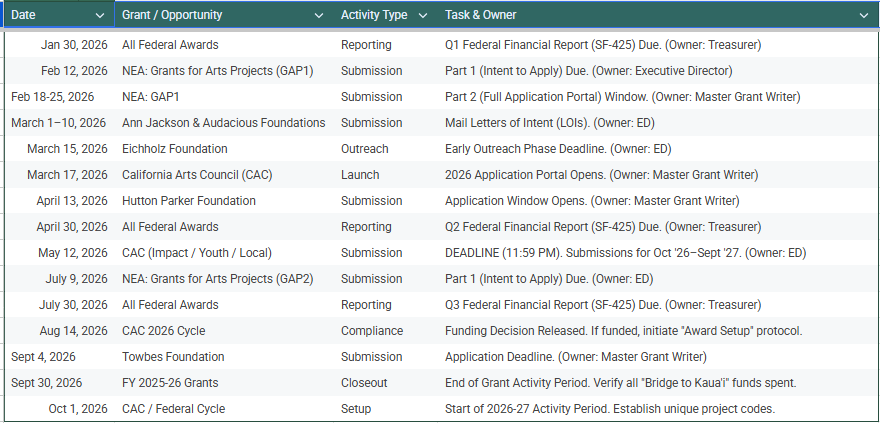
Master Award Grant Calendar
Internal Financial Controls Policy
Purpose & Objectives
The purpose of this policy is to establish a system of checks and balances that protect Hula Anyone Inc.’s assets, ensure the reliability of financial reporting, and guarantee compliance with the OMB Uniform Guidance (2 CFR 200) for federal awards. Our objective is to maintain "Fiscal Integrity" in service of the preservation of Hawaiian culture.
Segregation of Duties
To minimize the risk of error or fraud, no single individual shall have control over all phases of a financial transaction.
Authorization: The Executive Director or Board Treasurer authorizes transactions.
Recording: The Bookkeeper/Accountant records transactions in the accounting software.
Custody: A separate staff member handles the physical deposit of checks or cash.
Reconciliation: Bank statements must be reconciled monthly by someone who does not have check-signing authority.
To ensure rigorous segregation of duties
The Bookkeeper—responsible for the daily recording of transactions and accounts payable—is a dedicated staff member (Treasurer) who holds no check-signing authority.
Conversely, the Independent CPA is a distinct third-party professional engaged annually to assist in tax compliance and accounting support and does not participate in the organization’s daily bookkeeping or management functions. This separation ensures that the recording, authorization, and review of financial activities are performed by separate individuals.
Disbursement and Purchasing
Check Signing: * Checks under $1,000 require one authorized signature (Executive Director).
Checks over $1,000 require two authorized signatures (Executive Director and Board Treasurer).
Expense Reimbursement: Employees must submit an itemized receipt and a signed expense report within 30 days. Reimbursements for the Executive Director must be approved by a Board officer.
Credit Cards: Organizational cards are issued only to authorized personnel. Personal use is strictly prohibited. Original receipts must be submitted for all "Hula Anyone" card transactions.
Revenue and Cash Receipts
Cash Handling (Workshops/Performances): For onsite events, two individuals must count cash together and sign a "Cash Transmittal Form."
Deposit Timeline: All funds (checks, cash, and digital payments) must be deposited into the corporate bank account within 72 hours of receipt.
Grant Revenue: Funds received for restricted purposes (e.g., a specific grant for "Kumu Training") shall be tracked in separate classes within the accounting system to ensure no commingling with general operating funds.
Asset Management & Inventory
Equipment: Any equipment purchased with grant funds exceeding $5,000
(e.g., high-end audio/visual equipment for recording hula) must be tagged, insured, and entered into a formal inventory log.
Physical Security: Financial records, unissued checks, and petty cash must be kept in a locked, fireproof cabinet.
Audit and Reporting
Monthly Reports: The Treasurer shall present a Statement of Activities (Income Statement) and a Statement of Financial Position (Balance Sheet) to the Board at every monthly meeting.
Annual Audit: If Hula Anyone Inc. expends more than $750,000 in federal funds in a single year, a Single Audit (formerly A-133) will be conducted by an independent CPA.
Even below this threshold, an annual financial review or audit is required by the Board.
Hula Anyone (International Hula Institute) operates in full compliance with the California Nonprofit Integrity Act and the Registry of Charitable Trusts. While currently below the $2 million audit threshold, the organization maintains rigorous internal oversight and is prepared to engage external CPA review services should projected grant awards elevate gross revenues above the $50,000 reporting threshold, ensuring absolute transparency and state-mandated compliance.
Maintenance of Procurement History Records
For every procurement transaction exceeding the Micro-purchase threshold (currently $10,000), Hula Anyone shall maintain a comprehensive Procurement File. This file must be retained for seven (7) years following the close of the grant and must include, at a minimum:
Rationale for the Procurement Method: Documentation explaining why a specific method (e.g., small purchase, sealed bid, or sole source) was selected.
Selection of Contract Type: Justification for the type of contract used (e.g., fixed-price or cost-reimbursement).
Vendor Selection or Rejection: Copies of all bids/proposals received, the scoring rubric or evaluation matrix used, and the written justification for the final selection.
Basis for Contract Price: A price or cost analysis demonstrating that the final price is fair and reasonable (e.g., comparison of quotes or historical data).
Cost Allocation Methodology (CAP)
Hula Anyone maintains a written Cost Allocation Plan to ensure that shared costs are distributed equitably across all programs and funding sources.
Direct Costs: Expenses that can be identified specifically with a particular final cost objective (e.g., a specific workshop or performance) are charged directly to that program.
Indirect/Shared Costs: Costs that benefit more than one program (e.g., studio rent, insurance, administrative utilities) are allocated based on a documented allocation base.
The Primary Allocation Base: Hula Anyone utilizes Direct Labor Hours (Total Personnel Effort) as the primary base for allocating shared costs. If a grant-funded program represents 40% of the total staff hours for a period, it shall be allocated 40% of the shared facility and administrative costs for that same period.
Consistency: Allocation methods are applied consistently across all funding sources and are reviewed annually during the budget reconciliation process.
Adopted: January 2025 - Reviewed: March 2026 - Next Review: March 2027
Financial Stewardship: Our Operating Reserve Policy
At Hula Anyone, we view cultural preservation as a long-term commitment. To ensure that our students, kumu, and community programs—including the Bridge to Kaua'i Scholarship Fund—are protected against economic uncertainty, our Board of Directors has established a formal Operating Reserve Policy.
1. Purpose of the Reserve
The Operating Reserve is a designated fund used to maintain the stability of our mission and ongoing operations. It provides an essential safety net that allows Hula Anyone to:
Maintain program continuity during unexpected revenue shortfalls.
Cover emergency expenses (e.g., facility issues or urgent cultural travel needs).
Bridge the gap between grant cycles and the timing of reimbursement-based funding.
2. Target Goal: 3 to 6 Months of Stability
Our strategic goal is to maintain an unrestricted operating reserve equal to three (3) to six (6) months of our average annual operating expenses. This "runway" ensures that our cultural work remains uninterrupted even during periods of transition or emergency.
3. Our "Reserve Building" Strategy
Hula Anyone is currently in a proactive Growth and Stabilization Phase. To reach and maintain our reserve targets, the Board of Directors has implemented the following fiscal disciplines:
Annual Allocation: A minimum of 5% of any year-end unrestricted surplus is automatically directed into the Operating Reserve.
Segregated Accounting: Reserve funds are tracked separately from our general operating cash and restricted scholarship funds to ensure they are available exclusively for their intended purpose.
Replenishment Mandate: If the reserve is accessed, the Board is required to implement a financial plan to restore the fund to its target level within twelve months.
4. Transparency & Accountability
We believe that fiscal health is a prerequisite for cultural health. We are proud to report our financial standing to our donors and grantors annually, ensuring that every gift contributes to a sustainable and resilient future for hula in our community.
Adopted: January 2025 - Reviewed: March 2026 - Next Review: March 2027
Hula Anyone Incorporated: Conflict of Interest Policy
Article I: Purpose
The purpose of this conflict of interest policy is to protect the tax-exempt interest of Hula Anyone Incorporated when it is contemplating entering into a transaction or arrangement that might benefit the private interest of an officer or director of the Organization or might result in a possible excess benefit transaction. This policy is intended to supplement but not replace any applicable state and federal laws governing conflict of interest applicable to nonprofit and charitable organizations.
Article II: Definitions
Interested Person: Any director, principal officer, or member of a committee with governing board-delegated powers, who has a direct or indirect financial interest, as defined below, is an interested person. Additionally, any member of an officer’s or director’s immediate family—including spouses, ancestors, children, grandchildren, great-grandchildren, and the spouses of children, grandchildren, and great-grandchildren—shall be considered an interested person for the purposes of this policy.
Financial Interest: A person has a financial interest if the person has, directly or indirectly, through business, investment, or family:
An ownership or investment interest in any entity with which the Organization has a transaction or arrangement.
A compensation arrangement with the Organization or with any entity or individual with which the Organization has a transaction or arrangement.
A potential ownership or investment interest in, or compensation arrangement with, any entity or individual with which the Organization is negotiating a transaction or arrangement.
Article III: Procedures
Duty to Disclose: In connection with any actual or possible conflict of interest, an interested person must disclose the existence of the financial interest and be given the opportunity to disclose all material facts to the directors and members of committees with governing board delegated powers considering the proposed transaction or arrangement.
Determining Whether a Conflict of Interest Exists: After disclosure of the financial interest and all material facts, and after any discussion with the interested person, he/she shall leave the board or committee meeting while the determination of a conflict of interest is discussed and voted upon. The remaining board or committee members shall decide if a conflict of interest exists.
Hula Anyone Incorporated operates under a formal set of Bylaws compliant with CA Corp Code § 5211. Governance is maintained through quarterly board meetings with a strictly enforced 51% quorum requirement. All material financial decisions and grant authorizations require a formal vote, recorded in minutes maintained by the Board Secretary, ensuring high-level fiduciary accountability and transparent leadership.
Procedures for Addressing the Conflict of Interest:
An interested person may make a presentation at the board or committee meeting, but after the presentation, he/she shall leave the meeting during the discussion of, and the vote on, the transaction or arrangement involving the possible conflict of interest.
The chairperson of the board or committee shall, if appropriate, appoint a disinterested person or committee to investigate alternatives to the proposed transaction or arrangement.
The board or committee shall determine whether the Organization can obtain with reasonable efforts a more advantageous transaction or arrangement from a person or entity that would not give rise to a conflict of interest.
Article IV: Records of Proceedings
The minutes of the board and all committees with board delegated powers shall contain:
The names of the persons who disclosed or otherwise were found to have a financial interest in connection with an actual or possible conflict of interest.
The content of the discussion, including any alternatives to the proposed transaction or arrangement.
A record of any votes taken in connection with the proceedings.
100% of our Board of Directors completes an annual COI disclosure, ensuring ethical stewardship of grant awards.
Article V: Annual Statements
Each director, principal officer, and member of a committee with governing board delegated powers shall annually sign a statement which affirms such person:
Has received a copy of the conflicts of interest policy.
Has read and understands the policy.
Has agreed to comply with the policy.
Adopted: January 2025 - Reviewed: March 2026 - Next Review: March 2027
Whistleblower Protection, Ethical Reporting Policy
All individuals with financial oversight must sign an annual Conflict of Interest statement.
Any staff member who suspects any financial mismanagement, legal violations, or severe ethical breaches (such as workplace safety, code of conduct violations, or harassment)
may report it directly to the Board Chair OR anonymously via our third party reporting system without fear of retaliation.
Hula Anyone Inc. is committed to the highest standards of ethical, moral, and legal conduct. In keeping with our commitment to Pono (righteousness), we encourage all employees, volunteers, and board members to share their questions, concerns, suggestions, or complaints with those who can address them properly. No director, officer, employee, or volunteer who in good faith reports a violation of the Code of Conduct, or a concern regarding financial or operational integrity, shall suffer harassment, retaliation, or adverse employment consequences. This policy is intended to encourage and enable individuals to raise serious concerns within the organization prior to seeking resolution outside the organization.
Escalation & Independent Reporting
While concerns should typically be reported to the Executive Director, if the concern involves the Executive Director, or if the reporter is not satisfied with the Executive Director’s response, the report should be made directly to the Board Chair or the Chair of the Audit Committee. if the complaint involves the Board Chair themselves e.g., may be filed alternatively with the Board Treasurer.
THIRD PARTY SECURE ANONYMOUS ENCRYPTED CONact Method
To ensure independence and anonymity, reports may be submitted via https://tips.hushline.app/to/HulaAnyone or by mail
marked 'Confidential: Board Chair' to the organization's registered address 1675 Shepard Mesa Ln. Carpinteria CA 93013
The Board Chair shall have the authority to initiate an independent investigation, potentially utilizing outside counsel or a third-party auditor, to ensure an unbiased resolution.
Adopted: January 2025 - Reviewed: March 2026 - Next Review: March 2027
Document Retention & Destruction Policy
To ensure the integrity and historical preservation of our 60-year legacy, Hula Anyone Inc. follows a strict Document Retention and Destruction Policy in accordance with IRS regulations and the Sarbanes-Oxley Act.
Permanent Records: Articles of Incorporation, Bylaws, IRS Determination Letters, and Board Meeting Minutes are retained permanently in both digital and physical archives.
Financial Records: Accounts payable ledgers, tax returns, and audited financial statements are retained for seven years.
Employment/Volunteer Records: Retained for seven years after termination or service completion.
All documents containing sensitive or identifying information are destroyed via secure shredding or permanent digital deletion after their retention period has expired to protect the privacy of our Ohana.
Adopted: January 2025 - Reviewed: March 2026 - Next Review: March 2027
Volunteer Management & Safety Policy
Purpose and Philosophy
Volunteers are the heartbeat of Hula Anyone Inc. Our goal is to provide a safe, respectful, and culturally enriching environment where volunteers can contribute to the preservation of hula. This policy ensures that volunteer engagement is structured, safe, and mutually beneficial.
Recruitment and Screening
To ensure the safety of our students—particularly minors and kupuna (elders)—the following screening protocols apply:
Application: All prospective volunteers must complete a formal application.
Background Checks: Any volunteer working directly with children, vulnerable adults, or handling finances must pass a national criminal background check and sex offender registry screening.
Orientation: All volunteers must undergo an orientation session covering Hula Anyone’s mission, cultural protocols, and safety procedures.
Time & Effort Documentation for Volunteers
To comply with federal 2 CFR 200 standards and state grant requirements, all volunteer hours utilized for grant-funded programs or as in-kind match must be documented using a contemporaneous logging system.
Primary Tracking System: Volunteers shall log hours via the [Digital Portal/Sign-in Sheet] at the time of service. Each entry must include:
Volunteer Name and signature (physical or secure digital).
Date of Service.
Start and End Times (Total Hours).
Activity Code/Program Description (e.g., 'Instruction - Project Alaka‘i').
Supervisor Verification: All logs must be reviewed and signed by a Program Lead or Officer at the conclusion of each event or month.
Retention Requirement: All original volunteer time records, including digital backups and physical sign-in sheets, shall be retained for no less than seven (7) years following the close of the grant period to satisfy audit look-back requirements.
Volunteer Status and Conduct
"At-Will" Volunteerism: Volunteer service is "at-will," meaning either the volunteer or Hula Anyone Inc. may terminate the relationship at any time, for any reason.
Code of Conduct: Volunteers are expected to represent Hula Anyone Inc. with the "Aloha Spirit." Harassment, discrimination, or culturally insensitive behavior will result in immediate dismissal.
Confidentiality: Volunteers may have access to sensitive information (donor lists, student records). All volunteers must sign a Non-Disclosure Agreement (NDA) as part of their onboarding.
Adopted: January 2025 - Reviewed: March 2026 - Next Review: March 2027
Safety and Risk Management
A. Physical Safety & Hula Instruction
Physical Limits: Volunteers assisting in dance instruction or event setup must be mindful of physical exertion. They are encouraged to communicate any physical limitations or health concerns.
Incident Reporting: Any injury or "near-miss" involving a volunteer must be reported to the Executive Director within 24 hours using the official Incident Report Form.
B. Youth Protection (The "Two-Deep" Rule)
To protect both volunteers and students, a volunteer must never be alone with a minor in a private setting. At least two authorized adults (staff or vetted volunteers) must be present during all youth-focused hula activities.
C. Equipment and Property
Volunteers must be trained before using any Hula Anyone Inc. equipment (e.g., sound systems, recording gear). Unauthorized use of organization property is prohibited.
Liability and Insurance
Waiver of Liability: All volunteers must sign a Release and Waiver of Liability before commencing service. This waiver includes a "Hold Harmless" clause regarding injuries sustained during dance or event activities.
Insurance: Hula Anyone Inc. maintains General Liability Insurance that provides secondary coverage for certain volunteer activities. However, volunteers are encouraged to maintain their own personal medical insurance.
Expense Reimbursement
Volunteers are generally responsible for their own expenses (travel, attire).
Any pre-approved expenses for Hula Anyone Inc. must be supported by original receipts and submitted within 30 days for reimbursement, per our Internal Financial Controls Policy.
Recognition and Documentation
Service Tracking: Volunteers are responsible for logging their hours.
Accurate tracking is vital for our Grant Reporting, as volunteer hours often count as "In-Kind" matching funds for federal and state grants.
Performance Feedback: Periodic check-ins will ensure the volunteer’s goals align with the organization's needs.
Adopted: January 2025 - Reviewed: March 2026 - Next Review: March 2027
ANTI-HUMAN TRAFFICKING AND MODERN SLAVERY POLICY
Purpose & Philosophical Alignment
Hula Anyone, Inc. operates on nearly six decades of tradition dedicated to keeping Pacific cultural heritage vibrantly alive, accessible, and respected. Our foundational values—rooted in Aloha (mutual respect, love, and compassion), Kuleana (sacred responsibility), and Malama (stewardship and protection)—dictate an unyielding commitment to human dignity, individual freedom, and ethical action.
Human trafficking, forced labor, and modern slavery are absolute violations of these values and stand in direct opposition to the preservation of life and culture. This policy establishes an explicit, zero-tolerance framework to prevent, identify, and eradicate any form of exploitation within our internal operations, cultural travel deployments, procurement streams, and partner collaborations.
Regulatory Compliance & Grant Safeguards
This document forms a core pillar of Hula Anyone, Inc.’s public transparency and compliance page (hulaanyone.com/compliance-accountability). It satisfies the mandatory certification requirements enforced by federal and state grant makers under:
2 CFR § 200 (Uniform Guidance): Standard Administrative Requirements and Cost Principles for Federal Awards.
Federal Acquisition Regulation (FAR) Clause 52.222-50: Combating Trafficking in Persons.
The California Transparency in Supply Chains Act.
Prohibited Conduct
All representatives of Hula Anyone, Inc. are strictly prohibited from engaging in the following actions, both within the United States and during domestic or international cultural exchange field operations:
Forced Labor: Engaging in, benefiting from, or facilitating any form of trafficking in persons, severe forms of trafficking, commercial sex acts, or the use of forced labor.
Document Exploitation: Destroying, concealing, confiscating, or denying access to any employee’s or practitioner's passport, driver’s license, or other immigration and identification documents.
Fraudulent Recruitment: Using misleading or fraudulent practices during recruitment or volunteer onboarding, such as failing to disclose basic terms and conditions of employment, travel, or fieldwork infrastructure.
Charging Recruitment Fees: Charging job applicants, performers, or project volunteers recruitment, onboarding, or administrative placement fees.
Substandard Housing: Failing to provide housing or lodging that meets local housing and safety standards when organizing residency accommodations.
Fieldwork Operational Matrix & Travel Safeguards
Because campaigns like Operation 'Eō E Emalani (The Bridge to Kaua'i Campaign) involve the transport and temporary residency of an intergenerational continuum of 30 practitioners—specifically including vulnerable minor youth (ages 13–17) and kūpuna (ages 70–80)—the following operational protocols are mandatory:
Verified Transport Channels: All commercial air travel, airport shuttles, and high-clearance ground transit (e.g., 15-passenger vans) must be booked directly through authorized organizational credit lines mapped to our QuickBooks class-ledger isolation rules. No third-party, unverified transport handlers may be utilized.
Chaperone & Custody Controls: Minors participating in cultural fieldwork must be accompanied at all times by background-checked cultural leads. Guardianship and medical liability waivers must stay permanently archived in Hula Anyone’s cloud-based compliance vault.
Secure Housing Infrastructure: Group base camps and lodging environments must be vetted in advance by the Director or a designated compliance officer to ensure safe egress, direct proximity to the group, and zero risk of isolation or exploitation.
Supply Chain & Procurement Vetting
While Hula Anyone, Inc. is a cultural arts public charity rather than a commercial manufacturer, we acknowledge our purchasing footprint. To maintain supply chain integrity:
Technical Hardware: Procurement of digital archiving hardware, weather-sealed 4K capture units, and multi-channel field recorders must be sourced from established corporate manufacturers (e.g., Sony, DJI, SanDisk) who publish formal modern slavery statements.
Performance Regalia & Event Materials: For clothing, traditional texturing, and performance regalia ordered for community concert events, Hula Anyone, Inc. prioritizes verified ethical vendors, indigenous artisans, and local businesses that guarantee fair wages and transparent labor conditions.
Reporting, Whistleblower Protections, & Enforcement
Hula Anyone, Inc. protects those who act as stewards of our community's safety:
Mandatory Reporting: Any employee, volunteer, or practitioner who witnesses, suspects, or receives an allegation of human trafficking or exploitative behavior must immediately report it directly to the Director, Angelita Eller (805-451-0589 | aloha@hulaanyone.com).
Protection Against Retaliation: In accordance with our strict internal whistleblowing rules, Hula Anyone, Inc. enforces a zero-tolerance policy against retaliation. No individual will suffer adverse career, volunteer, or artistic standing for reporting a well-founded suspicion of trafficking.
Global/Federal Escalation: Individuals may also report concerns directly to the Global Human Trafficking Hotline at 1-888-373-7888 or the National Center for Missing & Exploited Children if minors are involved.
Disciplinary Actions
Any individual or contracted vendor found to have violated this policy, or to have falsely/maliciously accelerated a claim in bad faith, will be subject to immediate disciplinary actions. This includes termination of employment, permanent revocation of volunteer status, cancellation of vendor contracts without termination penalties, and immediate escalation to Santa Barbara County law enforcement or federal authorities.
Board Approval & Policy Attestation
This compliance framework is formally ratified by the Hula Anyone, Inc. Board of Directors. It shall be reviewed annually alongside our asset inventory controls to ensure total regulatory compliance as our footprint expands.
Adopted: January 2025 - Reviewed: March 2026 - Next Review: March 2027
Gift Acceptance Policy
Mission Alignment & Ethical Standards
Hula Anyone Inc. shall only accept gifts that are consistent with its mission, values, and 60-year legacy of cultural integrity.
Conflict of Interest: No gift shall be accepted that results in a private benefit to any individual associated with Hula Anyone Inc.
Cultural Sensitivity: Gifts of tangible property (e.g., historical artifacts, instruments, or costumes) will be evaluated by the Kumu Hula (Executive Director) to ensure they are handled with proper cultural protocol and can be appropriately stewarded.
Authority to Accept Gifts
Routine Gifts: The Executive Director is authorized to accept cash, checks, and publicly traded securities.
Non-Routine Gifts: Gifts of real estate, closely held securities, or those with significant restricted purposes require review by the Gift Acceptance Committee (comprised of the Board Treasurer, Executive Director, and an outside legal/financial advisor if necessary).
Would result in a net financial loss or unreasonable administrative burden (e.g., maintenance costs exceeding the gift's value).
Originates from sources whose values are fundamentally at odds with the "Aloha Spirit" or indigenous stewardship.
Donor Acknowledgment & Disclosure
Hula Anyone Inc. complies with IRS Publication 1771. We will provide a contemporaneous written acknowledgment for all single contributions of $250 or more.
Legal Advice: Hula Anyone Inc. does not provide legal or tax advice. Donors are strongly encouraged to consult with their own professional advisors.
Adopted: January 2025 - Reviewed: March 2026 - Next Review: March 2027
Cyber-Security & Data Privacy Policy
Purpose and Scope
The purpose of this policy is to safeguard the digital assets of Hula Anyone Inc., including donor records, student information, and proprietary cultural intellectual property. This policy ensures compliance with federal and state data privacy laws and establishes a "Security-First" culture.
Financial Data & Payment Processing (The PayRoc Partnership)
To ensure the highest level of security and to maintain PCI-DSS Compliance, Hula Anyone Inc. adheres to a "Data Minimization" strategy for financial transactions:
Third-Party Processing: All credit card transactions and electronic payments are processed through PayRoc, our authorized third-party financial processor.
Non-Retention Policy: Hula Anyone Inc. does not store full credit card numbers, CVV codes, or sensitive banking credentials on internal servers, local computers, or paper files.
Encryption: All payment data transmitted via the Hula Anyone website is protected via Secure Socket Layer (SSL) encryption, directly interfacing with PayRoc’s secure gateway.
Data Classification
Public: Information intended for public consumption (e.g., workshop schedules, public hula history).
Internal: Non-public organizational data (e.g., internal memos, curriculum drafts).
Confidential (PII): Highly sensitive data including donor contact info, employee tax records, and student health waivers. This data requires the highest level of encryption and access control.
Access Control & Identity Management
Principle of Least Privilege: Staff members are granted access only to the data necessary for their specific role.
Multi-Factor Authentication (MFA): MFA is mandatory for all organizational accounts, including email (Google Workspace), cloud storage, and any financial dashboards.
Password Integrity: Passwords must be a minimum of 12 characters, including a mix of alphanumeric and special characters, and must be updated if a breach is suspected.
Device and Network Security
Managed Devices: Any device used to access Hula Anyone data must be password-protected and equipped with up-to-date antivirus software.
Public Wi-Fi: Staff are prohibited from accessing the internal database or PayRoc dashboard over unencrypted public Wi-Fi without the use of an approved Virtual Private Network (VPN).
Data Retention and Disposal
Retention: We retain data only as long as required for business operations or as mandated by grantors (typically 3–7 years).
Secure Disposal: Physical records containing PII must be cross-cut shredded. Digital data must be "wiped" using industry-standard disk-clearing software before hardware is decommissioned or recycled.
Incident Response Plan (IRP)
In the event of a suspected data breach:
Detection: Notify the Executive Director and IT Lead immediately.
Containment: Isolate affected systems to prevent further data loss.
PayRoc Coordination: If a financial data breach is suspected, PayRoc support must be notified immediately to secure the merchant gateway.
California Data Privacy & Breach Compliance (SB 446 / Civ. Code § 1798.82)
Individual Notification: Affected California residents shall be notified within 30 calendar days of the discovery of the breach.
Attorney General Notification: If a single breach affects more than 500 California residents, a sample copy of the breach notification must be electronically submitted to the California Attorney General within 15 calendar days of notifying the affected individuals.
CPRA Framework: While primarily categorized as a 501(c)(3), the organization voluntarily aligns with CPRA 'Best Practices' for the protection of 'Sensitive Personal Information' (SPI) to ensure the highest standard of donor stewardship.
Training and Awareness
All staff must undergo annual Cyber-Security Awareness Training, focusing on phishing recognition, social engineering, and the proper handling of sensitive cultural data.
Adopted: January 2025 - Reviewed: March 2026 - Next Review: March 2027
Acceptable Use Policy: Artificial Intelligence (AI)
Purpose and Philosophy
Hula Anyone Inc. recognizes that Artificial Intelligence (AI) can serve as a powerful tool for operational efficiency and educational outreach. However, as an organization dedicated to the authentic preservation and teaching of Hula and Hawaiian culture, we prioritize human expertise, cultural sensitivity, and data sovereignty. This policy ensures that AI is used to augment—never replace—the human connection and cultural integrity of our mission.
Core Ethical Principles
Cultural Integrity: AI shall not be used to generate or "interpret" sacred cultural knowledge, genealogy, or traditional hula choreography without the express oversight and validation of a qualified Kumu Hula.
Transparency: Any public-facing content (blogs, educational materials, or grant reports) substantially generated by AI must be disclosed as such.
Equity and Bias Mitigation: Users must critically evaluate AI outputs for Western-centric biases that may misrepresent or marginalize Indigenous perspectives.
Permitted Use Cases (The "Green Zone")
The following administrative tasks are approved for AI assistance, provided a human reviews the final output:
Administrative Efficiency: Drafting meeting agendas, summarizing internal notes, and scheduling.
Data Analysis: Analyzing donor trends or program attendance figures (provided no Personally Identifiable Information is uploaded).
Initial Drafting: Creating "straw-man" drafts for marketing copy, social media captions, or standard business emails.
Hula Anyone is committed to the ethical and transparent use of Artificial Intelligence. We embrace 'Green Zone' technologies—specifically the Google Workspace AI ecosystem and Canva—to amplify our capacity to preserve Hawaiian culture. We maintain a 'Human-in-the-Loop' policy: every AI-generated document is rigorously reviewed and verified by a human subject-matter expert to ensure cultural accuracy and fiscal integrity.
Hula Anyone: "Green Zone" AI Transparency List
1. Google Workspace for Nonprofits (Gemini Integration)
Application: Standard administrative tasks, including drafting donor thank-you letters, summarizing board meeting transcripts, and optimizing grant narratives.
Compliance Factor: Data processed through our Workspace Enterprise account is governed by a Data Processing Addendum (DPA). Google does not use Hula Anyone’s internal data to train its public models, ensuring institutional privacy.
2. Gemini Gems (Custom Agents)
Application: We utilize custom "Gems" as digital assistants trained on our specific internal guidelines—such as a "Grant Master Gem" for style consistency and a "Kuleana Gem" for organizational protocol.
Compliance Factor: These Gems act as private, internal logic layers that only interact with approved, non-sensitive data sources.
3. NotebookLM
Application: Our primary tool for Cultural Knowledge Synthesis. We upload 60+ years of institutional history, workshop notes, and ethnographic research into private "Notebooks" to generate study guides for students and citations for grant proposals.
Compliance Factor: NotebookLM provides a "Grounding" mechanism that ensures all AI-generated content is strictly derived from our uploaded source materials, eliminating "hallucinations" of cultural facts.
4. Canva Magic Studio
Application: Creation of educational flyers, social media graphics for the Hula Anyone workshops, and layout design for our annual reports.
Compliance Factor: Used only for visual assets. Staff are prohibited from uploading identifying photos of minors or students without explicit, signed FERPA/Privacy waivers on file.
5. Gemini (Standard App - Logged In)
Application: Rapid research on foundation trends, finding public census data for "Needs Statements," and brainstorming marketing headlines.
Response Time: We aim to respond to all accessibility inquiries within three business days.
Adopted: January 2025 - Reviewed: March 2026 - Next Review: March 2027
Procurement & Vendor Selection Policy:
General Procurement Standards - Regulatory Authority: 2 CFR 200.318–327 (Uniform Guidance)
Hula Anyone Inc. shall maintain oversight to ensure that contractors perform in accordance with the terms, conditions, and specifications of their contracts.
Fair and Open Competition: All procurement transactions for each Festival, regardless of dollar amount, shall be conducted in a manner that avoids even the appearance of restrictive competition.
No Geographic Preference: In accordance with federal law, Hula Anyone Inc. shall not use state or local geographical preferences in the evaluation of bids or proposals, except where applicable federal statutes expressly mandate or encourage it.
Methods of Procurement
Hula Anyone Inc. utilizes the following methods based on the "Aggregate Dollar Amount" of the purchase:
Micro-Purchases (up to and including $10,000): May be awarded without soliciting competitive price or rate quotations if the price is considered reasonable. To the extent practicable, these purchases must be distributed among qualified suppliers.
Small Purchase Procedures ($10,001 - $250,000): Relatively simple and informal procurement methods for securing services or supplies. Price or rate quotations must be obtained from at least three (3) qualified sources.
Competitive Proposals (Above $250,000): Used for large-scale festival needs (e.g., primary staging, international travel, or venue security). This requires a formal Request for Proposals (RFP) or Request for Qualifications (RFQ).
The RFP Process for Festivals
For all "Small Purchase" and "Competitive Proposal" tiers, the following must occur:
Clear Specifications: The RFP must incorporate a clear and accurate description of the technical requirements for the material, product, or service to be procured.
Public Posting: RFPs shall be publicized on the Hula Anyone website and sent to a diverse list of potential vendors to ensure a broad pool of applicants.
Evaluation Criteria: Bids will be evaluated based on a "Weighted Scoring Rubric" including:
Technical expertise and experience with cultural festivals.
Price/Cost-effectiveness.
Capacity to meet the Festival timeline.
Commitment to DEI and socioeconomic diversity.
Socio-Economic Contracting (2 CFR 200.321)
Hula Anyone Inc. will take all necessary affirmative steps to assure that small and minority businesses, women's business enterprises, and labor surplus area firms are used when possible. This includes:
Placing qualified small and minority businesses on solicitation lists.
Assuring that such businesses are solicited whenever they are potential sources.
Dividing total festival requirements, when economically feasible, into smaller tasks or quantities to permit maximum participation.
Conflict of Interest & Ethical Conduct
Organizational Conflict: No employee, officer, or agent of Hula Anyone Inc. shall participate in the selection, award, or administration of a contract if a real or apparent conflict of interest is involved.
Gifts: Officers and employees may neither solicit nor accept gratuities, favors, or anything of monetary value from contractors or parties to subcontracts.
Documentation and Record Keeping
The rationale for the method of procurement.
The selection of contract type.
The contractor selection or rejection rationale (e.g., the scoring rubrics).
The basis for the contract price.
Contract Provisions
All contracts for any Festival exceeding $10,000 must address administrative, contractual, or legal remedies in instances where contractors violate or breach contract terms, and provide for such sanctions and penalties as appropriate.
Adopted: January 2025 - Reviewed: March 2026 - Next Review: March 2027
Worker Classification & Independent Contractor Compliance Policy
(California AB5 / AB2257 Standards)
Statement of Intent
Hula Anyone Inc. is committed to legal and ethical labor practices. While we prioritize a stable core staff of employees to manage our 60-year legacy, we also recognize the vital role of independent cultural practitioners. This policy ensures that all independent contractor (IC) relationships meet the rigorous "ABC Test" or qualify for specific statutory exemptions under AB2257.
The Default Standard: The "ABC Test"
In accordance with California law, Hula Anyone Inc. presumes all workers are employees unless they meet all three criteria of the ABC Test:
A. Control: The worker is free from the control and direction of Hula Anyone Inc. in connection with the performance of the work.
B. Scope: The worker performs work that is outside the usual course of Hula Anyone Inc.’s business. (Note: This is the highest hurdle for arts orgs; therefore, we prioritize statutory exemptions).
C. Independently Established: The worker is customarily engaged in an independently established trade, occupation, or business of the same nature as the work performed.
Statutory Exemptions (The AB2257 "Arts" Protections)
Hula Anyone Inc. will primarily engage independent contractors who fall under the Professional Services or Music/Performance Professional exemptions. To qualify, the contractor must:
Maintain a Separate Business: Possess a business license and a Federal Tax ID (EIN).
Control the "How": Set their own hours and use their own tools/instruments.
Multi-Client Status: Provide services to other organizations or the public, demonstrating they are not economically dependent solely on Hula Anyone Inc.
A. Music and Performance Professional Exemption
For the any Festival and special workshops, Hula Anyone may contract with musicians and performers as ICs, provided:
They are not "replacing" an employee.
They retain the rights to their own musical/performance intellectual property.
They are not under the "primary control" of the organization regarding the artistic expression of their performance.
Mandatory Documentation (The "Contractor Packet")
No independent contractor shall be paid until a "Contractor Packet" is on file, containing:
Written Contract: Explicitly stating the contractor's control over their work and their responsibility for their own taxes and insurance.
IRS Form W-9.
Proof of Business Status: A copy of a business license, professional website, or business card.
Certificate of Insurance (COI): Identifying the contractor’s own professional liability or workers' comp coverage (if applicable).
Prohibited Practices
To maintain the integrity of IC status, Hula Anyone Inc. staff shall not:
Provide contractors with "Employee Handbooks."
Require contractors to attend internal staff meetings or non-essential administrative training.
Provide the contractor with equipment that the contractor should reasonably provide themselves (e.g., specific costumes or instruments).
Dictate a rigid "9-to-5" schedule for a contractor; rather, we set "deliverable deadlines" or "performance times."
Adopted: January 2025 - Reviewed: March 2026 - Next Review: March 2027
Annual Classification Audit
The Board Treasurer and the Executive Director shall conduct an annual review of all 1099-NEC recipients to ensure that their roles have not "morphed" into employee-like relationships. If a role is deemed essential to the day-to-day business (Part B of the ABC test) and does not meet a specific AB2257 exemption, the position must be converted to an employee status (W-2).
Corporate Patronage & Qualified Sponsorship Policy
Purpose: To define the parameters under which Hula Anyone Inc. accepts corporate financial support while strictly preserving its federal tax-exempt status and safeguarding the sacred cultural protocols (kapu) of traditional Hawaiian hula.
I. Core Philosophy & Cultural Paramountcy (Kapu)
Hula Anyone Inc. operates not as a commercial entertainment group, but as a depository and school of living Hawaiian heritage, lineage, and history.
Absolute Cultural Autonomy: The Kumu Hula (Master Teacher) retains absolute, non-negotiable authority over all artistic, spiritual, and educational expressions of the hālau.
Sanctity of the Regalia and Implements: Traditional dance garments (regalia/ʻahu), body adornments (lei), and musical implements (ipu, ʻiliʻili, etc.) are sacred. Under no circumstances shall any corporate logo, brand name, trademark, or commercial symbol be displayed on the bodies, attire, or implements of the dancers, or within the sacred performance space.
No Artistic Direction: No corporate benefactor or sponsor shall have any input, control, vector of influence, or veto power over the selection of chants (oli), dances (hula), historical narratives, choreography, event locations, or casting of performers.
II. Strict IRS Compliance & Unrelated Business Income Tax (UBIT) Prevention
To protect Hula Anyone Inc.’s 501(c)(3) status and ensure all incoming corporate funds are treated as tax-exempt "Qualified Sponsorship Payments" under Internal Revenue Code (IRC) Section 513(i), the hālau strictly prohibits commercial advertising.
1. Absolute Prohibition of Advertising
Hula Anyone Inc. will not provide, or allow its platforms to be used for, corporate advertising. As defined by Treas. Reg. § 1.513-4(c)(2)(v), prohibited advertising activities include, but are not limited to:
Qualitative or Comparative Language: The hālau will never use terms that praise the sponsor’s business or products (e.g., stating a sponsor is "the best," "most reliable," or "excellent").
Price Information: The hālau will not publish prices, indices, savings metrics, or valuations of a sponsor’s products or services.
Endorsements: The hālau will not provide testimonials or imply that Hula Anyone Inc. recommends or vouches for the sponsor's business.
Inducements: The hālau will never publish calls-to-action, incentives to buy, or links that directly facilitate a commercial purchase or transaction.
2. Contingency Safeguards
Corporate financial commitments must be flat, unconditioned donations. No payment to Hula Anyone Inc. shall be contingent upon event attendance, website traffic metrics, digital impressions, or the scale of public exposure. Any agreement containing such performance metrics is explicitly void under this policy.
III. Permitted Corporate Recognition Limits
Corporate recognition by Hula Anyone Inc. is strictly passive and limited to the definition of a "Qualified Acknowledgment" under IRS guidelines.
Location of Recognition: Corporate recognition is restricted solely to the dedicated "Mahalo" page on the official Hula Anyone Inc. website. Sponsors will be listed strictly alongside public grants, individual community donors, and philanthropic foundations.
Permissible Materials: Digital acknowledgment on the "Mahalo" page may include only:
The formal legal name or trade name of the corporation.
The official corporate logo (free of promotional text).
Value-neutral contact information (corporate address, phone number, and a direct hyperlink to the corporation’s primary homepage).
Hyperlink Guardrails: The permitted hyperlink must point to the corporate entity’s main landing page. It must never direct users to a product sales page, a promotional discount sheet, or an interactive shopping cart.
IV. Policy Execution and Agreement Clause
Every corporate entity wishing to financially support Hula Anyone Inc. must execute a formal Corporate Patronage Agreement incorporating this policy verbatim.
Policy Acceptance Clause: By providing funds to Hula Anyone Inc., the donor acknowledges that this transaction is a qualified, non-commercial contribution. The donor waives all rights to promotional advertising, product endorsement, and creative or administrative influence over the hālau, its students, its Kumu, and its sacred cultural presentations.
Adopted: January 2025 - Reviewed: March 2026 - Next Review: March 2027
Policy Statement: Anti-Terrorism and Non-Violence Compliance
1. Purpose and Scope
Hula Anyone is deeply committed to upholding the highest legal, ethical, and moral standards across all organizational operations and program delivery. In strict compliance with United States federal law, including the USA PATRIOT Act (Uniting and Strengthening America by Providing Appropriate Tools Required to Intercept and Obstruct Terrorism Act of 2001) and all associated Executive Orders, this policy establishes a zero-tolerance framework regarding terrorism and violence.
This policy applies universally to all funds, resources, and assets received by Hula Anyone from any source, including but not limited to federal, state, and local government grants, private foundation awards, corporate sponsorships, and individual donations.
2. Explicit Prohibitions
Hula Anyone strictly prohibits the use of any portion of its funding, directly or indirectly, to:
Support, facilitate, or fund individuals, entities, or organizations associated with terrorism.
Finance acts of terrorism, violence, or ideological extremism.
Subsidize, partner with, or distribute sub-awards to any group, institution, or individual that incites, condones, or promotes violence in any form.
3. Compliance and Verification Measures
To ensure absolute compliance with this mandate, Hula Anyone implements rigorous operational safeguards:
Vetting and Screening: Prior to entering into any contract, partnership, or sub-award agreement, Hula Anyone cross-references all potential vendors, contractors, and organizational partners against the Office of Foreign Assets Control (OFAC) Specially Designated Nationals (SDN) and Blocked Persons List, as well as the federal System for Award Management (SAM) exclusions database.
Financial Controls: All expenditures are subject to strict internal accounting controls, requiring detailed documentation, receipts, and multi-level management approval to ensure funds are utilized exclusively for authorized, peaceful, and lawful programmatic purposes.
Mandatory Reporting: Any employee, board member, or volunteer who suspects or identifies a potential violation of this policy is required to report the matter immediately to the Executive Director or Board of Directors for immediate investigation and corrective action.
Grant Proposal Clause ("Patriot Act" Compliance)
Instructions for Use: The following text can be copied directly into federal, state, or foundation grant applications within sections addressing organizational governance, legal assurances, or financial compliance.
Anti-Terrorism and Non-Violence Assurances (USA PATRIOT Act Compliance)
Hula Anyone explicitly certifies that it will not utilize any funds, resources, or assets derived from this grant award to support, facilitate, or fund terrorists, terrorist organizations, or any entity or individual that incites, promotes, or condones violence in any manner.
In strict compliance with United States federal law, including the USA PATRIOT Act of 2001, Executive Order 13224, and all applicable anti-terrorism statutes, Hula Anyone maintains rigorous internal financial controls and vetting protocols. The organization systematically screens all contractors, vendors, and partners against the Office of Foreign Assets Control (OFAC) Specially Designated Nationals and Blocked Persons List. Hula Anyone guarantees that all grant-funded activities will be executed in full compliance with these legal mandates, ensuring that 100% of awarded funds are directed exclusively toward the lawful, peaceful achievement of the project’s stated objectives.
Adopted: January 2025 - Reviewed: March 2026 - Next Review: March 2027
Hula Anyone Incorporated: Sustainable Development Goals (SDG) Alignment
Hula Anyone Incorporated operates at the intersection of cultural preservation, community wellness, and lifelong education. By utilizing the traditional hula art form as a vehicle for social cohesion and physical health, the organization’s practices, philosophies, and goals directly operationalize three specific United Nations Sustainable Development Goals (SDGs).
SDG 11: Sustainable Cities and Communities
Target 11.4: Strengthen efforts to protect and safeguard the world’s cultural and natural heritage.
Philosophy & Principle: Hula is not merely a dance; it is an oral history, a linguistic repository, and a living record of Native Hawaiian and Pacific Islander heritage. Hula Anyone operates on the principle that a community’s resilience is directly tied to the preservation of its cultural identity.
Action & Practice: Through structured classes, workshops, and public performances, Hula Anyone actively safeguards Indigenous knowledge systems, traditional music, and choreography. By making these cultural practices accessible to diverse urban populations, the organization prevents the erosion of marginalized cultural heritages.
Goal: To ensure the longevity of Pacific Islander cultural traditions across generations, fostering an inclusive, culturally rich community fabric that honors historical accuracy and authentic lineage.
SDG 3: Good Health and Well-being
Target 3.4: Reduce premature mortality from non-communicable diseases through prevention and treatment and promote mental health and well-being.
Philosophy & Principle: Hula is a holistic physical and mental discipline. The connection between mind, body, spirit, and community (ʻOhana) is foundational to the practice, serving as a preventative health mechanism.
Action & Practice: As a low-impact, high-endurance cardiovascular activity, Hula Anyone’s programming improves mobility, core strength, and cardiovascular health, particularly among aging demographics and underserved populations. Furthermore, the communal nature of the classes mitigates social isolation, reduces cortisol/stress levels, and provides cognitive stimulation through complex choreographic sequencing and linguistic integration.
Goal: To deploy traditional dance as an accessible public health intervention that enhances both the physical longevity and emotional well-being of participants.
SDG 4: Quality Education
Target 4.7: Ensure that all learners acquire the knowledge and skills needed to promote sustainable development, including... appreciation of cultural diversity and culture’s contribution to sustainable development.
Philosophy & Principle: Education must extend beyond standardized curricula to include cultural literacy, empathy, and historical context. Learning hula is an immersive educational experience that teaches respect for the natural world (ʻĀina) and human interconnectedness.
Action & Practice: Hula Anyone provides rigorous, structured instruction that goes beyond physical movement to teach the Hawaiian language (ʻŌlelo Hawaiʻi), history, geography, and environmental ethics embedded within traditional chants (Mele).
Goal: To foster global citizenship and deep cross-cultural empathy by educating the public on the ecological wisdom and humanistic values foundational to Hawaiian culture.
Adopted: January 2025 - Reviewed: March 2026 - Next Review: March 2027
Operational Policies & Board Resolutions for Federal Compliance
Entity: Hula Anyone, Inc. (EIN: 87-4565201)
Status: 501(c)(3) Non-Profit Organization
Purpose: Formal adoption of internal policies required under SAM.gov Federal Financial Assistance Certifications and Representations to maintain an "Active" entity profile eligible for direct and pass-through federal funding.
1. Federal Labor Standards Compliance Policy
Policy Statement:
Hula Anyone, Inc. enforces strict compliance with all applicable federal labor standards, including the Fair Labor Standards Act (FLSA) (29 U.S.C. § 201 et seq.), the Davis-Bacon Act (40 U.S.C. § 3141 et seq.) where applicable to federally funded construction/renovation, and the Service Contract Act (41 U.S.C. § 6701 et seq.).
Fair Compensation: All personnel, instructors, and contractors supporting cultural arts initiatives—including intergenerational workshops and community education—shall be compensated in strict alignment with federal minimum wage, overtime regulations, and local prevailing wages.
Classification of Personnel: The organization strictly adheres to IRS and Department of Labor guidelines regarding the classification of independent contractors versus employees. Cultural practitioners, musicians, and guest instructors are engaged via legally compliant, written professional service agreements.
Non-Discrimination: In accordance with Title VI of the Civil Rights Act of 1964, employment practices and program delivery shall be entirely free from discrimination based on race, color, national origin, age, or disability. Hula Anyone, Inc. maintains an open, inclusive environment for all participants from ages 4 to 104.
2. Policy on Non-Delinquency on Federal Debt
Policy Statement:
In compliance with 28 U.S.C. § 3201(e) and the Federal Debt Collection Procedures Act, Hula Anyone, Inc. prohibits the submission of any federal grant application if the organization possesses an unresolved, delinquent debt owed to the United States government.
Financial Oversight: The Board of Directors and designated financial officers will review the organization's tax liabilities, corporate filings, and financial statements quarterly to ensure zero delinquency on federal payroll taxes, matching funds, or penalties.
Attestation Mandate: Prior to submitting any federal funding proposal, the authorized organization representative must verify via the System for Award Management (SAM.gov) that no active exclusions, tax liens, or federal debt defaults exist against EIN 87-4565201.
3. Anti-Lobbying Statute Compliance Policy
Policy Statement:
Hula Anyone, Inc. complies fully with 31 U.S.C. § 1352 (the Byrd Anti-Lobbying Amendment). Federal grant funds allocated to the organization shall never be utilized, directly or indirectly, to influence or attempt to influence an officer or employee of any federal agency, a Member of Congress, or an employee of a Member of Congress in connection with the awarding, making, or entering into of any federal contract, grant, loan, or cooperative agreement.
Segregation of Funds: The organization maintains rigorous fund accounting principles. Any permissible advocacy or localized civic engagement activities completely unrelated to federal lobbying must be financed entirely through non-federal, unrestricted general donations.
Disclosure Requirement: For any federal grant award exceeding $100,000, the organization will execute and file the mandatory Standard Form-LLL, "Disclosure of Lobbying Activities," if any non-federal funds have been used to influence a federal action.
4. Drug-Free Workplace Compliance Policy
Policy Statement:
In accordance with the Drug-Free Workplace Act of 1988 (41 U.S.C. § 8101 et seq.) and 2 CFR Part 182, Hula Anyone, Inc. certifies that it provides a safe, drug-free environment across all operational sites, rehearsal spaces, studio locations, and public forums where organizational programming takes place.
Prohibition of Controlled Substances: The unlawful manufacture, distribution, dispensing, possession, or use of a controlled substance is strictly prohibited within the organization's administrative offices, cultural workshops, community educational showcases, and during travel associated with institutional delegations (e.g., cultural heritage exchanges).
Employee and Volunteer Sanctions: Any employee, contractor, or volunteer found in violation of this policy will face immediate corrective action, up to and including termination of employment or contract cancellation, and referral to law enforcement when applicable.
Grantee Notification Obligation: If an individual personnel member is convicted of a criminal drug statute violation occurring in the workplace, Hula Anyone, Inc. will notify the federal awarding agency in writing within ten (10) calendar days of receiving notice of the conviction.
Adopted: January 2025 - Reviewed: March 2026 - Next Review: March 2027

Hula Anyone Inc. is a vetted and certified partner on the Benevity platform. Corporate employees can now double their impact through employer gift matching.